RITM promotes scholarly exchange through workshops, conference panels, and other academic events organized by the network and its members. Below is an overview of these activities.
- 2026
- 2025
- Ritual, Power, and the Power of Ritual in the Ancient Near East: Power and Ritual (Céline Debourse & Elizabeth Knott)
- 2024
- Ritual, Power, and the Power of Ritual in the Ancient Near East: Ritual and Kingship (Céline Debourse & Elizabeth Knott)
- 2023
Shaping Men, Shaping Worlds: Masculinities in Ancient Western Asia
27–28 August 2026 · University of Helsinki
Organized by Gioele Zisa and Ellie Bennett
The research of masculinities in ancient Western Asia studies has grown rapidly in recent years. Although the field occasionally considered non-women genders in earlier scholarship, it was not until the Mapping Ancient Near Eastern Masculinities conference in 2011 and the subsequent volume Being a Man: Negotiating Ancient Constructs of Masculinity (ed. Ilona Zsolnay, 2017) that masculinities emerged as a sustained focus within ancient Western Asian studies. Since then, interest in the topic has continued to expand, reflected in a steady flourishing of workshops, monographs, and articles.
Fifteen years on, it is time to assess and further stimulate this area of research with a dedicated workshop. While the Gender and Methodology in the Ancient Near East (GeMANE) workshops have provided an essential platform for gender studies in the field, their primary focus has remained on women. Yet even in GeMANE the growth of interest in masculinities studies has been noted, as an entire panel was dedicated to the topic in GeMANE 6.
The upcoming workshop, “Shaping Men, Shaping Worlds: Masculinities in Ancient Western Asia”, hosts papers that explore recent developments in the study of masculinities in ancient Western Asia. This includes papers covering a large geographical and chronological time span, including Egyptology and biblical studies. In the workshop we will also examine how in ancient Western Asia the natural world is used to construct masculinities through metaphor, but also to understand the gender of non-human entities. Methodological reflections on this topic will be discussed.
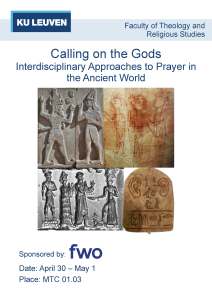
Calling on the Gods – Interdisciplinary Approaches to Prayer in the Ancient World
30 April–1 May 2026 · KU Leuven
Organized by Spencer Elliott
Prayer was an inescapable element of religious life in the ancient world. Significant examples of prayer are available in sources from ancient Egypt and West Asia, found on a diverse range of media, and these have long attracted scholarly attention, whether as part of collections or as individual texts. Importantly, the evidence for these prayers is entirely restricted to written prayers found in texts. Each religious system was unique, but prayer found its way into writing in each of these settings. Though this limits our access to prayer as a religious practice, it provides a common set of methods and approaches for contemporary researchers, ones filtered through the scribes and scholars of the past. Prayer is only one component of a religious system, but its ubiquity in these different cultures provides a hub by which to correlate different approaches and theories from antiquity.
Within this written form, a discussion of prayer can go in a multitude of different directions, focusing on material, ritual, or scribal settings. The material settings for these prayers vary widely: Egyptian prayers are found on tomb walls and papyri, Mesopotamian prayers are found on clay tablets, and prayers from ancient Israel are preserved in much later biblical manuscripts. Apart from speaking with the authors, writers, or readers of these texts, scholarship on these texts requires a certain degree of imagination and creativity in understanding these texts and the religious and social worlds they represent. Though all written prayers imagine a setting of communication between a deity and a petitioner, written prayer could have political or social applications, and ritual uses of a prayer always need to be proven. Contributors to this conference are encouraged to contemplate this complexity in the evidence, and so to discuss prayer in how it relates to ritual theory, how prayer moves beyond ritual performance, and how the written medium of our evidence challenges our access to prayer as a religious practice.
Reading the Sky: Divination, Hermeneutics, and Documentation in Ancient Mesopotamia
19 January 2026 · LMU Munich
Organized by Saki Kikuchi
In ancient Mesopotamia, celestial phenomena were regarded as divine signs predicting the fate of kings and their lands. By the early seventh century BC, Assyrian kings commissioned celestial experts to observe and report these signs as guidance for decision-making. The long tradition of celestial divination and its specialized training cultivated the vigilant observation skills of Assyrian celestial experts, directing their attention toward significant phenomena in the night sky. Most celestial reports centered on omen quotations used to interpret the divinatory significance of observed events. However, interpretation often went further. Multiple omens could be attached to a single observation, or additional commentary could be provided. Statements like “the moon is seen on the 14th day” may appear straightforward observational records. However, as Wainer (2016) has shown, some are actually commentary, making it difficult to determine how observations were documented and reflected. This suggests that not only divinatory texts but also hermeneutic rules and techniques shaped the practice of celestial observation. This workshop will examine the relationship between observation, interpretation, and documentation, focusing on the role of hermeneutics in celestial observation and report-making. Topics include the function of hermeneutics in Mesopotamian scholarship, the use of quotation sources, the narrative and physical structure of documentation, the nature of specialized training, and the social networks and status of the experts involved.
Ritual, Power, and the Power of Ritual in the Ancient Near East: Power and Ritual in the Ancient Near East
21 November 2025 · Annual Meeting of the American Society of Overseas Research (ASOR), Boston
Organized by Céline Debourse and Elizabeth Knott
Rituals are powerful tools that can make or break the socio-political status quo, and those who command ritual hold a special kind of sway over other people. But what does it mean to wield ritual as a socio-political tool? In this two-year session, we will explore who harnessed the power of ritual, how they did so, to what aims and ends, and how reliable these ritual strategies were. During the first year we focused on ANE kingship and its rituals (“Ritual and Kingship in the Ancient Near East”), asking what royal ritual can teach us about the institution of kingship. In the second year, we will expand our outlook to understand how any ANE person or social group could use ritual to exert and subvert social or political power (“Power and Ritual in the Ancient Near East”). For both sessions, we welcome papers from archaeologists, art historians, and philologists.
The 2025 “Power and Ritual in the Ancient Near East” Session explores the socio-political power of ritual and how various ritual actors could tap into or subvert that power. A wide range of individuals and groups were involved in ritual performances. Rituals were often designed for kings, but they were not necessarily designed by kings. Who instructs who in ritual performance? And how to the presence and actions of various individuals and parties shape the experience of ritual? What traces of power plays can be found in the textual and material records? In this session, we will explore ritual from different perspectives – through texts, ritual theories, aspects of materiality, and architecture.
Divination and Daily Life
9–10 July 2025 · 70e Rencontre Assyriologique Internationale (RAI), Prague
Organized by Saki Kikuchi, Mary Frazer, and Aino Hätinen
While many of our sources for divination practices in the ancient Near East reflect divination’s application in the service of kings, activities such as stargazing, extispicy, augury, and lecanomancy were embedded in the daily rhythms of communities apart from the ruling elites. These practices depended on observations of the natural world and materials of daily use, and they were accordingly directly tied to lived experiences and environments. To explore the ways in which divinatory practices shaped, and were shaped by, the material and social conditions of everyday existence we invite scholars to contribute papers to a panel on Divination and Daily Life.
By focusing on the tangible and practical aspects of divination, this panel aims to illuminate the embeddedness of these practices within the fabric of daily life in ancient Mesopotamia. We welcome submissions from diverse disciplinary perspectives, including history, philology, archaeology, and anthropology.
Ritual, Power, and the Power of Ritual in the Ancient Near East: Ritual and Kingship
22 November 2025 · Annual Meeting of the American Society of Overseas Research (ASOR), Boston
Organized by Céline Debourse and Elizabeth Knott
Rituals are powerful tools that can make or break the socio-political status quo, and those who command ritual hold a special kind of sway over other people. But what does it mean to wield ritual as a socio-political tool? In this two-year session, we will explore who harnessed the power of ritual, how they did so, to what aims and ends, and how reliable these ritual strategies were. During the first year we will focus on ANE kingship and its rituals (“Ritual and Kingship in the Ancient Near East”), asking what royal ritual can teach us about the institution of kingship. In the second year, we will expand our outlook to understand how any ANE person or social group could use ritual to exert and subvert social or political power (“Power and Ritual in the Ancient Near East”). For both sessions, we welcome papers from archaeologists, art historians, and philologists.
The 2024 “Ritual and Kingship in the Ancient Near East” Session explores royal ceremonies, and the intrinsic links between ritual performance and kingship. Ernst Kantorowicz described the Medieval European king as having “in him two Bodies, viz., a Body natural, and a Body politic” (The King’s Two Bodies, 1957), and as one point of discussion we consider how ritual was a powerful tool for reconciling these two Bodies. Rituals were often exclusively designed for kings and kings participated in rituals as both performers and audience members. But what purposes did these ceremonies serve? What desired outcomes did they have, and how did they achieve those? What can these rituals tell us about the institution of kingship in different Ancient Near Eastern cultures? And what do they tell us about the individual who sat on the throne? In this session, we will explore royal ritual from different perspectives – through texts, ritual theories, aspects of materiality, and architecture.
Who is it (good) for? Ritual texts and ritual performances
17 July 2023 · 68e Rencontre Assyriologique Internationale, Leiden University
Organized by Beatrice Baragli, Jon Beltz, Céline Debourse, Spencer Elliott, Elizabeth Knott and Evelyne Koubková
Ritual performances have the capacity to reshape, leverage, or affirm structures and norms of established socio-political hierarchies. But whether written instructions for them reflect their actual performances remains open to debate. Without the opportunity to observe ancient Mesopotamian rituals, what can we say about their social dynamics on the basis of textual evidence alone?
This workshop pauses to reflect on decisions that led to the writing down of ritual texts. Who wrote them and for whom? Who was present in or absent from such texts? How did they represent performance and what kind of biases might they have introduced? Who benefited from written representation of performance? What other discourses might these texts have carried? In other words, who are the texts (good) for?
Because Sumerian and Akkadian written tradition did not define ritual texts or their purpose, only a general sense of their form and function is current in modern scholarship. Most often the genre of “ritual texts” is defined as those that describe, or prescribe, a sequence of ritual actions, often in a durative verb construction in the second person. Although ritual texts give the impression of providing instructions for ritual performance, most do not include enough information to carry them out. Moreover, these texts could be copied and recopied over an extended period of time, so the preservation of a written tradition may or may not have corresponded to a continuity in ritual practice across time and space.
Instead of viewing ritual texts as imperfect representations of ritual performance, this workshop considers other possible functions for them in ancient societies. In many cases, ritual texts were a product of elite scholarship and advanced literacy, mediating access to a very specific representation of ritual practice by and for the select few. The mere existence of these technical texts thereby contributed to this elite group’s cultural capital. A variety of experiences with and relationships to ritual texts can be approached through close examination of discourses used to record instructions for ritual performance (dromena) and ritual speech (legomena). Related textual production in other media as well, such as inscribed amuletic objects worn by both literate and illiterate users, may also be considered, for there the importance of writing itself encapsulated the symbolic value assigned to this advanced technical literacy.
From the prominent position of priests and scholars in the crafting and transmission of ritual texts, to the diversity of use and reception in their various forms among a wider population of users, this workshop examines the specifically textual nature of our evidence for Mesopotamian rituals and the place of these texts in ancient society.

