Members of RITM have received a range of awards and prizes in recognition of their research and scholarly contributions. The distinctions listed below reflect the diversity and excellence of the work carried out across the network.

Céline Debourse wins Beresheet Grant for Outstanding Young Researchers 2026
This project challenges the prevailing view of Babylonian religion as an unchanging tradition that disappeared with the end of cuneiform culture. It investigates how foreign imperial domination, political marginalization, and growing cosmopolitanism transformed religious ideas and practices between 484 BCE and 75 CE. Integrating textual and material evidence, it examines three interconnected dimensions: evolving temple practices, changing conceptions of the divine, and religious expressions beyond institutional settings. By tracing the interplay between continuity, innovation, and diversification, the project offers the first comprehensive history of Late Babylonian religion, illuminating broader religious transformations in the ancient Near East.

Saki Kikuchi wins Dr. Gerhard Ott Prize 2025
In ancient Mesopotamia, days were interpreted as inherently positive or negative, which affected the results of activities or what happened on that day. This doctrine of essentially good and bad days was documented in a group of calendrical texts called “hemerologies” in modern terminology. Hemerologies determine whether a certain day is positive or negative. In addition, we have texts that ask about the appropriateness of a certain activity based on the quality of the day. These texts thus offered advice on everyday life about whether the desired action should be carried out or not on the day in question. The aim of this work is to present a systematic presentation of hemerologies from Mesopotamia in the first millennium BC with thematic studies on various aspects.
The dissertation was published with Zaphon, 2024.
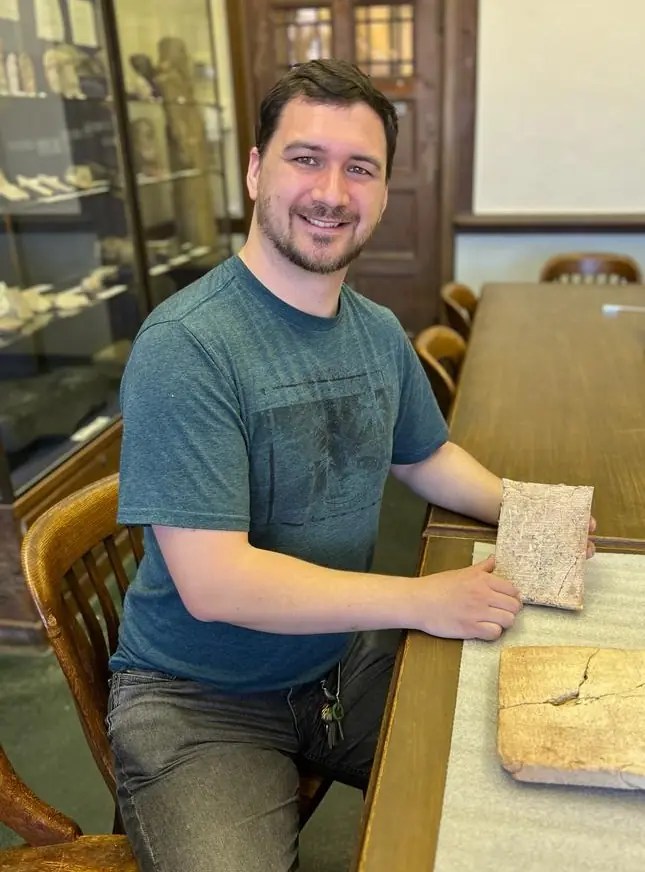
Jon Beltz wins The William J. Horwitz Prize at Yale University 2023
The categories of gods, demons, and monsters in ancient Mesopotamian cultures remain a popular topic in scholarship, whether in surveys of Mesopotamian religions, collected studies on demonology, or monographs devoted to individual gods and demons. Yet certain divine beings exhibiting characteristics of both gods and demons—thereby eluding easy classification—have yet to be the subject of their own in-depth studies. This is the first monograph-length study to focus on Namtar, charting his place in the Mesopotamian divine cosmos and situating him between the categories of “god” and “demon.” The evidence used in this study is the wealth of textual sources available to modern scholars on cuneiform tablets, spanning from the third millennium BCE down to the end of the first millennium BCE. Not only does this work provide a profile of an important Mesopotamian Underworld god and disease demon, it also has wider implications for the conceptualization of divine beings more generally. By studying Namtar’s liminal position between gods and demons, we can test and challenge approaches to mapping out the Mesopotamian pantheon within Assyriological research, arriving at more precise ways to describe ancient Near Eastern divine beings.

Evelyne Koubková wins IAA Dissertation Prize 2026
The exorcist (āšipu/mašmaššu) was a prominent ritual expert, healer, and scholar in ancient Mesopotamia. He was responsible for the performance of a wide range of rituals that cared for the physical, mental, social, and religious well-being of individual clients. His ability to expel and protect from evil powers of any kind, including evil demons, ghosts, diseases, and witchcraft, required the authority to gain his clients’ trust in the effectiveness of his rituals and superiority among his competitors. This thesis analyzes the exorcist’s self-presentation in a substantial corpus of ritual texts from the first millennium BCE and shows how ritual practice shaped this expert’s authority. Through repeated ritual performance, as well as the related study of ritual texts, the exorcist’s idealized professional identity could materialize as a social reality. I analyze the exorcist’s authority on its own terms and evaluate various etic labels’ analytic usefulness for describing this prominent ancient expert.

Beatrice Baragli wins ERC Starting Grant 2025
Sumerian is probably the earliest recorded language of mankind, and its writings are among the most important sources for the study of the ancient Near East. It has been documented in the cuneiform script for over three millennia. However, two fundamental questions remain unanswered: Why did the cultural and religious elite of the ancient Near East continue to use the Sumerian until the beginning of the Common Era, if the last native Sumerian speaker passed away no later than 2000 years before? What enabled Sumerian to trump many other languages of that time in terms of longevity? In her ERC project LASU Beatrice Baragli wants to prove that Sumerian survived for so long because it was considered sacred. Taking an innovative philological and religious-historical approach, LASU aims to apply a unique, language-order-based framework for deciphering Sumerian’s interactions with other languages of the multilingual ancient Near East of the first millennium BCE.
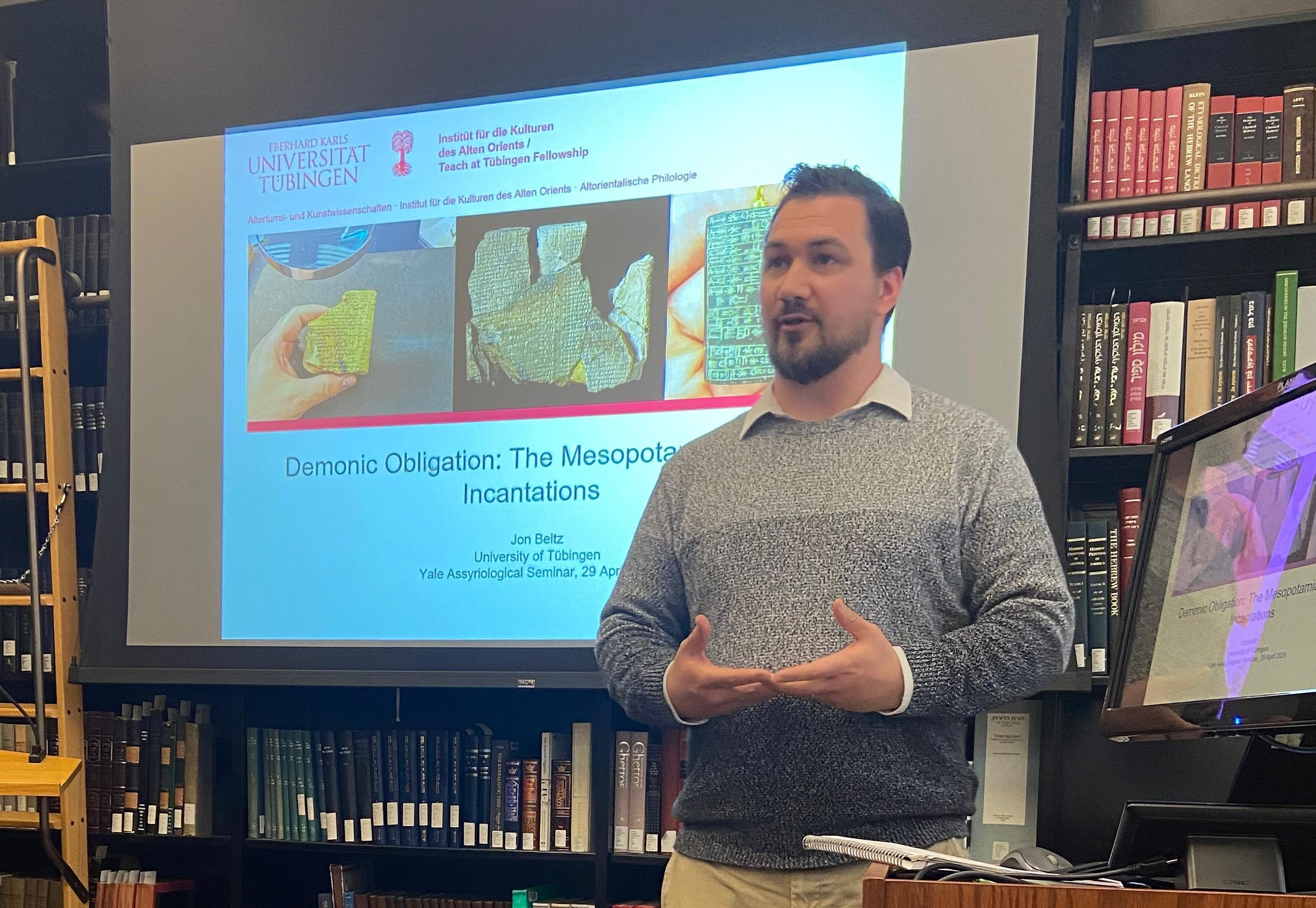
Jon Beltz wins IAA Best Article of an Early Career Scholar Prize 2025
Most of the Mesopotamian incantation texts available to modern scholars, especially those from earlier periods (ca. 2500 to 1500 BCE), maintain an uncertain relationship with actual magical praxis. That is, given their manuscript and archival contexts, it is difficult to say whether they had actual ritual use, or how closely their texts resemble those that were actually used by ritual practitioners. Inscribed amulets, however, represent an exception: since they are objects actually used for healing and protection, the texts on them must represent texts that were actually used in ritual contexts. This article published four Sumerian amuletic incantations of the zi–pa₃ type, which contain similar incantation texts, and two of which were published for the very first time. It provides a structural comparison of their similarities and compares them further with other early Sumerian incantations, some from well-attested compositions such as Udug-ḫul, demonstrating that these texts are quite similar to their amuletic counterparts. These similarities suggest that the Sumerian incantation corpus is not that different from texts that were actually used for healing and protective purposes. And yet, at the same time, the differences among the amuletic texts (and between the amuletic texts and the greater Sumerian incantation corpus) suggest that the texts used were not mindlessly copied, but adapted and adjusted by ritual practitioners, likely to suit individual clients’ needs. These four small amulets, then, have a lot more to tell us than just giving us new—and early!—examples of zi–pa₃ incantations, they also help us get a better understanding of how early Sumerian incantations may have been used in everyday practice.

